RSS Feed MEI Podcast
transcript.jpg

The Situation in Iraq, February 7, 2008

 
Featuring:
Ambassador David Satterfield
Introduction:

Michael Ryan: Welcome my name is Michael Ryan, and I am from The Middle East Institute. Do we have a treat for us today. When I was like many people I suspect forced to study ancient Greek as a youth one, of the strange things they made us memorize was “the wise man is the citizen of the world”. So if the wise man is the citizen of the world, then Ambassador David M. Satterfield must be wise indeed. He is here to tell us about that world especially focusing on Iraq, and I don’t want to delay him because I understand he has to leave sharply at 11:00 or slightly before. So I just tell you a couple things I think you already know, this is the reason you are here. He has a long career in the Department of State, he became a Senior Advisor to the Secretary of State and Coordinator for Iraq in August. That follows his service as a DCM in Baghdad, but he was also Principal Deputy Assistant Secretary of State for the Bureau of Near Eastern Affairs in 2004 until 2005. He was a Principal Deputy Assistant Secretary, he was an Ambassador to Lebanon, he spent time on the Arab-Israeli, he has been all over the issues on the Middle East. So I don’t want to delay him, just one slight advertisement for MEI, in that we have a not unrelated conference on Iran that we had on Friday here, it was well attended, and very exciting, with voices from the region and voices that we all know and love from around here. So if you go to www.mideasti.org you can see that and our other programs, I invite you to do that. Thank you to Patton-Boggs for the use of the room. And with no more ado, Ambassador Satterfield, thank you Sir.

Ambassador David Satterfield: Thanks very much and I want to express special thanks to someone who is not here today, to David Mack who made this possible. There are many old friends and old faces here today, and I look forward to a good discussion. I am sorry that shortly after 11:00 I’ve got to be up on the Hill for what will be an infinitely less pleasant experience; a briefing on the strategic framework of the Status Forces Agreement which we will be starting negotiations upon very shortly this month with the Iraqi government. I am not sure experience is necessarily corollary to wisdom, but I will attempt to give you, as frank as possible an assessment of where we see the situation in Iraq today, where we see it going, and where the administration is placing its focus during its remaining months of the president’s tenure. Three critical lines of operation in Iraq: security, economic, and political progress, and I do not put them in that order because of any precedence all are essential.

The security track has seen over the last twelve months a great degree of progress. Progress in the sense that in the last twelve months more Iraqi citizens in more places are more secure than at any point since, what we now refer to as the insurgency, began in the latter months of 2003, and the beginning of 2004. By any metric, 2007 has witnessed a progressive decline both in attacks and also in levels of causalities among Iraqi civilians, and most recently, although there are occasional spikes, but trend lines show most recently a drop in attacks and casualties upon the US forces and Iraq security forces. There are several pieces of the calculus that put together have produced this dramatic improvement in security.

The first is the surge, the surge of additional US forces, retention in Iraq beyond their scheduled departure date, of additional US forces, but beyond numbers alone, the way those forces were being applied. The experiences of failed Baghdad security plans, of failed efforts to quell the sectarian violence that erupted after the February 2006 Golden Mosque bombings, gave us the backdrop of what not to do. Clear needs to be clear, secure needs to be genuinely, with adequate forces for an adequate period of time, secure an area fraught with sectarian killings, sectarian violence, or sectarian cleansing, and then build, has to mean just that, build upon what has been done to address the kinetic the violent nature of the conflict, and then begin addressing through economic means, and ultimately through political means the roots and the accelerance of that conflict.

Second key element, more Iraqi forces, primarily army, are more capable of partnering with us in a more effective fashion to help us achieve security in and outside of Baghdad. Third element, the so-called Anbar Awakening, which in fact is a process of tribal and non-tribal Sunni movement away from attacks on coalition forces, US forces, Iraqi forces, and symbols of the Iraqi government, towards attacking Al-Qaeda, constraining Al-Qaeda’s ability to operate. The awakening movements started in Anbar, moved well beyond, have had a significant double effect not only have they removed brought down to very little levels attacks by these elements Sunni insurgents upon coalition and US forces, they have also constrained Al-Qaeda’s ability to operate. Now I have to make a caveat here. Al-Qaeda remains a violent, lethal, and effective force in Iraq they are on the run, they are under increasing constraints, but they are very lethal. The character of their operations will continue to reflect their desire to sell violence, to exacerbate sectarian differences, to show that the government of Iraq is incapable of producing security for its people. But the means they use to conduct those operations have changed as it has become harder and harder for them to operate in those areas where previously they had essentially free reign. The suicide attacks in Baghdad a weekend ago, mentally disturbed women with remotely detonated suicide vests, is an indicator both of the lethality and the continued violent intent of Al-Qaeda, but also the constraints upon its ability to conduct what it would once have called “quality operations” specifically targeted at Shia in order to provoke Shia/Sunni violence. The attacks that were conducted in Baghdad were largely directed at areas where many people mingled from many different sects. We think this is because doing other kinds of operations has become increasingly hard for them, but they are still quite active. They are specifically active in the in the Kirkuk area, and I’ll talk a little bit about the Kirkuk, Article 140 Resolution question. We will continue to pursue them, we will continue to focus on Al-Qaeda as one of the sources of violence, as one of the accelerance of violence.

But there is one final factor responsible for this calculus of reduction in violence, and that is fragmentation within the Jaish al-Mahdi, the cease fire declared by Muqtada from his self imposed exile in Iran, the fragmentation, I don’t say disintegration, because I think that is far too strong a term, but fragmentation within the Jaish al-Mahdi’s process that began rather spectacularly on November 30, 2006, when Muqtada al-Sadr made a political gamble which he rather decisively lost. He declared that if Prime Minister Maliki went to Amman to meet with the President to discuss the basis for a surge of US forces and a Baghdad security plan, which would in our view and ultimately accepted by Prime Minister Maliki, have to result in the attack on direction of kinetic operations against anyone involved in violence whether they were part of the Jaish al-Mahdi, the Bahdal Organization, any other Shia collective, as well as Sunnis. Muqtada pulled his forces out of government said if you go and meet with the president we’ll leave. Well he left and nothing happened. That is nothing happened in terms of impact on the government. He did not have the political weight to sway the government, to sway the Shia coalition, but the act of his pulling out and nothing happening coupled with our assurances about the surge about to begin led Prime Minister Maliki to change his position. An individual had previously been presumed to be reliant upon support from the Sadrist movement unwilling to tackle the Jaish al-Mahdi, Sadr City off-limits, senior Jaish al-Mahdi’s lieutenants off-limits for coalition activities, changed his position and changed it very quickly. Senior lieutenants of the Jaish were wrapped up, Sadar City was entered, Muqtada left for Iran, where he, except for a few intervals in Iraq, remains today. A deeply troubled, I think, young man trying to figure out what his role is in an Iraq which is changing beyond his ability to decisively influence. That has been a major factor in reduction in violence as well, but security progress, dramatic as it is, cannot by itself produce true security lasting stability in Iraq. And I quote here Ray Odierno, who I think has said this the best; “The security gains impressive as they are, will remain fragile and they will remain reversible unless they are secured by economic, social, and political progress, above all progress towards political reconciliation this alone will truly stabilize and secure a very fragile Iraq.”

On the economic side, 2007 witnessed a significant improvement in security performance where it matters, ability of the central government to execute a capital budget, ability of the central government to move funds to provinces as provincial governments in turn are better capable of identifying local needs and moving project activity, a better ability to provide essential services. Now while improvement has been significant, 2007 over any previous year, a lot of work remains to be done. Capital budgets have moved from perhaps 15 percent execution rates in 2006 to what we estimate would by the end of 2007 ultimately be seen somewhere in excess of 65 percent. Spend rates, actual moneys burned through for real things or services, lower levels but still in order of magnitude improvement, essential services such as water, electricity, fuel, better situation but demand has consistently risen above the level of even increased delivery for production of power of water…a lot of work remains to be done. It’s work that will need to be done on the economic side, not just through better performance of the Iraqi government and provincial governments, but also by more attractive environment for investment for private as well as public sector moneys from the region outside coming into Iraq, to help Iraq meet what the World Bank in 2004 estimated to be a one hundred billion dollar overall redevelopment reconstruction need.

Political Process, through 2007 the political process was the lagging indicator. When Ryan Crocker and David Petraeus addressed the Hill on where things stood in mid-September of last year, they described practical pragmatic accommodations being made on the ground which had the effect of substituting for an almost entirely absent national political dialogue political process reconciliation process. Ryan also in his remarks described Iraq as a country in a state of revolutionary transformation and change, social, political, and economic. That reconciliation, in an absolute sense of the word, was a long-term evolutionary perhaps generational goal, but that the imperative to begin the process of putting in place the pieces of the building blocks of that ultimate goal of reconciliation had to start, and had to start now. We’ve seen over the course of the last 90 days, I think the most significant progress on the political track that we have witnessed in the last several years. Pieces of legislations, a pensions bill, which incorporated many elements of a very large and ultimately discarded de-Baathification reform bill, was adopted in December. Another version of de-Baathifciation itself was adopted in January, and just this past Sunday passed through the Presidency Council. The Council of Representatives is debating literally today, this week, two other critical pieces of legislation.

First the 2008 budget this is an excellent budget, it is by any definition a national budget. It represents real compromise and accommodation between Kurds, Sunnis, Shias. It contains over fifty percent increases in the capital investment budget for the government as a whole, for provincial funding, as well as a significant increase in Iraqi funding for the costs of Iraq’s own security forces. That’s a particularly dramatic point because Iraq’s budget outlays in support of its own security forces, as opposed to USG outlays for those forces, has gone from zero three years ago to somewhere to the vicinity of two-thirds of the total funding costs and we expect those numbers to continue to increase.

The other bill currently pending before the Council of Representatives is a significant piece of national legislation; it is a Provincial Powers Law. It is the first attempt to define the nature of federalism of central-periphery relations in Iraq since the drafting of the constitution, which as many of you may know, left these questions for ultimate resolution in the form of other statutes to be passed. Our view is that there is no right or wrong formula that defines federalism whether in the United States or in any other country. It’s an emergent evolutionary definition that changes as those circumstances in those countries change, as circumstances in our country have changed over the last two hundred plus years. But what’s essential is that is that a best balance be struck, between center and periphery interests concerns now, to begin the process of moving forward. Moving forward not just in defining federalism as an abstract, but also as the necessary base for providing for new provincial local elections by the end of this year. Iraq’s political leaders have defined this definition of federalism as the essential first step, the door through which progress, the ultimate holding of provincial elections has to pass, and those elections are very important. They are important because they will correct two significant distortions or imbalances. The first distortion is of course is the absence of significant Sunni participation in the original local electoral process.

But the second distortion is a very different one and it may ultimately be a more significant one. It is a popular reaction throughout Iraq at the quality and the character of their local representatives. The non-representative character of these individuals who were chosen under a closed list system in which voters voted for a party as symbol and number, not for individuals. Now we believe, we think it’s the global experience that the more attenuated the link between elected official and elector is, the less responsible, the less accountable, the less representative they become. So a more open rather than less open of a system would be best for these elections, but our views here will not be disposited.

What is much more interesting is something else that has been happening in Iraq, and to which the national leadership is beginning to respond. As security has improved, as it no longer is the focal point, the be all end all for peoples lives and concerns, people are starting at local levels and increasingly pressuring their national representatives for movement, for movement not just on essential services and economic issues that are certainly there, but movement as well in the political process. There is an increasing reaction against non-representative, non-functional or dysfunctional local or national governance. Why would the national parties wish to accommodate these pressures? After all it’s their oxen collectively being gored, by more representative open-list elections that will be a precedent ultimately for the basis on which national elections will in a short while have to be held. Well the answer to that is they don’t necessarily want to see this, but they are being forced to accommodate. Now I will give you a couple good examples.

The Sunni Tawafic movement, Sunni IIPs, initial reaction to the phenomenon of the tribal awakenings, the Anbar Awakenings, and the move of those awakenings from strictly military, constraining Al-Qaeda, strictly dealing with military coalition, military Iraqi security forces, and coalition entities, into nascent political parties, was to pretend they didn’t exist, or that they had no place. “Who were these local elements, who were these tribal figures to presume that they could have a political role?” Well that was an initial reaction. The reaction over the last several months has been a very different one: “let’s make a deal, we the established Sunni parties would like to work with you, we need you, you may need us as well.” That’s the kind of pragmatic politics that we think is extremely healthy, extremely positive, but it needs to be translated in the form of actual elections, real political processes on the ground. We do believe elections can be held at a local level this year, it will require a lot of work, in addition to the passage of the Provincial Powers Law. It will require local elections law itself be passed that defines the basis for elections.

There is a lot of work that needs to be done both at the government and at the national level of preparing the electorates. But we do believe this is a critical goal. More importantly it is increasingly being defined as an essential goal by Iraqis themselves beyond the elections, beyond the budget, beyond the Provincial Powers Law, there are other critical pieces of the reconciliation puzzle for Iraq that should move forward. There is an amnesty law that has been proposed by the office of the Prime Minister. That law which was really more of a judicial cleansing law, i.e. “let’s get people out of the system that really shouldn’t be there or don’t need to be there” than it was a reconciliation measure, is now in the process of being amended and debated, and that’s very interesting. The law did not pass simply because it had come from the Prime Minister’s office. When Sunni and other elements weighed in and said this really should be a reconciliation vehicle, and to do that you need to expand the scope of the law, the law and interactive debate. Now it isn’t finished, debate is actually going to continue beyond this present session which will conclude at whatever point this month the budget is actually voted forward and adjourned in some thirty days, but it is a very positive development, and we do hope that it will come to closure this spring.

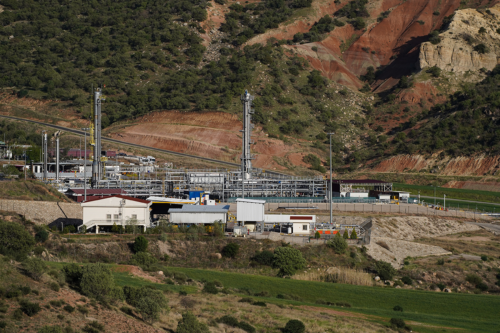
Now the final critical element of the reconciliation package, the benchmark package as we used to refer to it, is the hydrocarbon’s law, the national hydrocarbon’s law. Their progress has been very slow, and quite difficult. It is not a question of revenue distribution. Most of the parties in Iraq, sectarian or ethnic, would acknowledge that national distribution of hydrocarbon based revenues is at a pretty equitable fair basis. The issue is the magnitude overall of those revenues. Iraq has relied upon something over which it exercises no control, the pricing of oil on a global market, to fund its expanding budget. It has not expanded production significantly, it has not expanded export capacity significantly, although it did gain from improved security in the north, which allowed some additional 250 to 300 thousand barrels a day to be exported in a fairly consistent manner through Turkey, an export that had been denied for the previous four years, because of security threats. But production and export really haven’t improved, only pricing has gone up and that can’t stay that way. For all Iraqis to benefit to the extent that anyone looking at that sector would see as possible, they will require foreign investment. Foreign investment, frankly, is simply not going to flow in meaningful fashion in the absence of a modern national hydrocarbons law.

Now Under-Secretary of State Rubin Jeffery has been working this issue. He has been twice to Iraq he has meet there with the principal parties both in the Kurdish regional government’s, as well as the Iraqi government’s side, and he will be going to again to Iraq very shortly to work this issue. But what is necessary here in our view is a coming together by sides who have a profound distrust of each other, who hold perhaps different ideologies regarding market forces and the shape of market processes, who are concerned that neither will benefit from yielding to the other. That point of win-lose, lose-win has to be transformed into a very different kind of common win-win or lose-lose propositions.

The Secretary of State in her most recent meetings last night in Iraq was quite blunt with all of the leaders with whom she spoke, including Massoud Barazani, that in the absence of a national hydrocarbon law unilateral actions undertaken by either side will yield nothing but progress down a very bad and ultimately non-productive road. That they will send increasingly confused signals both to Iraqis, but also to the international community about what is the true intent of Iraq to move forward in this critical revenue-generating sector. But again progress on this issue, while essential, is very very difficult. We will keep working, we will keep our dialogue going with both sides, but this is something that will require a great deal of effort to overcome the very strong, if not increasing distrust between the parties concerned.

This year, 2008, will witness a significant change in the nature of the US relationship with Iraq. We have pledged, the Iraqi government has pledged, the Security Council has acknowledged, that by December 31st of this year the Chapter 7 mandate over Iraq which provides the basis for the multinational force in Iraq to be present and to conduct operations should be terminated. For that termination to take place there will have to be negotiated a sovereign-state-to-sovereign-state alternate arrangement between our two sides. And in fact, we hope later this month to begin the process of negotiating a status of forces agreement with the government of Iraq. An agreement that would contain as all status of forces agreements do, the essential authorities necessary for US forces to be present in Iraq and be on simple to be able to contact the kind of operations necessary for them to be effective in prosecuting the global war against terror from within Iraq, as well as providing the assistance necessary to a Iraq’s special forces in combating other sources of violence within that country. We hope very much to be able to bring these negotiations to a satisfactory close, to enable that Chapter 7 mandate again to be ended no later than the end this year.

We will also be discussing with Iraq a strategic framework, a framework that will building upon the declaration of principals agreed between the President and Prime Minister Maliki last November, layout our shared vision, our common vision, of where our partnership takes us on security, on social, on economic, on cultural and scientific issues, over the time ahead. We believe that a long-term relationship, strategic relationship, between the United States and Iraq is essential for US interests the interests of the Iraqi people broadly for the interests of the region and the international community. The status of forces agreement will provide the basis for a US force presence in Iraq to help from the aspect of force operations, the stabilization the securing of Iraq which still remains necessary. We hope to peruse in other non-military tracks an enhanced cooperation with the government of Iraq that will in other areas solidify both our relationship, but solidify Iraq as a nation, as a nation present and active within the Middle East and within the international community.

A brief final word about Iraq’s neighbors. Iraq doesn’t exist in a vacuum, Iraq exists in a neighborhood. What the neighborhood does or does not do affects Iraq, affects our interests in Iraq, affects security and stability in Iraq. The President’s recent trip to the Gulf and to other key Middle Eastern states, the president reiterated one key theme, it’s essential for the neighbors of Iraq to be positively constructively engaged in helping to build a stable secure Iraqi nation. We understand, we hear very clearly, the concerns about Iraq’s Sunni-Arab neighbors, about Iran’s hegemonic ambitions. We share those concerns. We share them profoundly we understand the concerns of Iraq’s neighbors about Sunni-Islamist terror, obviously we share and understand those concerns as well, but the best way to address those concerns is in the context of Iraq. It is not to turn one’s back to Iraq, to its emerging polity, it is not to deny or question, or be ambiguous, or ambivalent about the legitimacy of Iraq’s democratic processes, or a post-Saddam, post-Sunni-Bath Iraq. It is to engage with Iraq. It is to support moderates in Iraq. When Tariq al Hashemi went to Kuwait about a month ago as head of the National Delegation he represented the government of Iraq not the Sunni community, and what he said in Kuwait was it is essential for Iraq to have support from its neighbors, political engagement, diplomatic presence, so that the largest mission in Iraq of foreign states other than the US not be that of Iran. The Arab states should be present and they should see for themselves what is happening and not rely on second and third-hand and fourth-hand information. That was a very positive message and was especially positive because it was delivered by a Sunni leader, not representing his sect, but representing the government of Iraq. More such dialogue and exchange needs to be held but it can’t be one sided. It can’t be Iraq reaching out only the neighbors of Iraq need to reach out as well.

Iran. Iran remains, we believe determined to peruse its goal of departure of US forces, under as difficult circumstances as possible both as in means of securing its ambitions in Iraq per se, as well as projecting through and beyond Iraq its broader regional, and though its nuclear program, international ambitions. Iran remains lethally engaged in terms of providing training and equipment to the most radical most violent forces in Iraq. Attacks by those forces continue attacks on US forces by foreign projectiles have increased over recent months, so have indirect fire attacks on Basra Air Station. Both seen as bellwethers of Iranian backed violence. It is essential that Iran be approached as a strategic challenge because Iran looks at the region, at the international community, and at Iraq in a strategic fashion.

So this administration is addressing the challenges posed by Iran at an international level through the Security Council, at a bilateral state to state level, and at an institutional level financial and commercial level but this is and will remain a strategic challenge for some time to come, and when the President visited the gulf he heard, as we have all heard, from our friends and partners there, their strong concern over Iran’s ambitions what Iran was doing to fulfill those ambitions, and he heard one other thing. He heard that an arrangement on the status of forces agreement between Iraq and the United States was an extremely positive and welcomed development, and that by contrast a precipitated withdrawal of US forces, a precipitated withdrawal of the US presence in Iraq, would be viewed by those states as disastrous from the standpoint of their interests and broader regional interests.

We hope by the end of this administration to be able to leave to the next president, whoever he or she may be, an Iraq which is more stable more secure than it has been, a US relationship with Iraq that is stable and projectable over the long-term. We will not and we cannot bind a new US administration. That is not our intent. It is to allow that new administration options and time to reflect upon both our interests in Iraq, broader regional and international interests, and how that new administration will wish to peruse them. Thank you very much, and I am happy to take your questions.

Question & Answer:

Question: There has been a fair amount of analysis and some confusion as to what the deBaathification legislation in Iraq actually accomplishes. Some people have written and noted that it might even exacerbate the problem as implemented. Since the administration is making a great deal of this, what specifically does this legislation do, and in what way in a concrete sense redress the problems that were introduced by deBaathification and does it make it worse in any way? And just one last thought I saw that in the end of last year you were quoted as saying you thought Iran was exercising some restraint in fueling sectarian violence in Iraq. Have you changed that view in light of what you just said here about the increase in attacks in Bosra Air Station and elsewhere?

Ambassador David Satterfield: With respect to the deBaathification law we have had long discussions with Tariq al Hashemi, with other Sunni leaders, and with the other non-Sunni political leaders in Iraq over just the question you pose. Was this law a positive development or not? We believe it is. No side got a maximal position. Recall that the Saddarists wanted no deBaathification law at all. They wanted tightening and extension of the sweeping powers deBaathification authorities. Many in the Sunni community wanted an essential reversal of deBaathification completely. This was a compromise that is what legislation tends to be, people don’t get maximum positions.

What’s critical here though is implementation and execution. Could the law be wielded in a fashion which was prejudicial to national reconciliation to inclusion? Yes, it could, but the law also has provisions that are enormously expansive and encompassing and embracing and positive. The issue here is how it is implemented, how the commission, the seven members who will be named by the council of minister who will be approved by the Council of representatives, vetted by the Presidency council, how they ‘ll be chosen, how they will function, what they will do. Everything depends upon implementation and execution and that is a process in which we and others will be very much engaged. I can tell you the leaders of Iraq, the political block leaders have pledged an inclusive reconciliation spirit of implementation, but this is something that will need indeed to be watched. You know we talked just about any law, any legislative step in Iraq, it’s implementation and execution that is going to be critical here beyond the face of the law itself.

The question you asked about Iranian intent: certainly any demonstration that Iran was exercising any form of restraint, which incidentally no one would argue including me, was based upon anything other than a reading of Iran’s self-interest at a given moment, as to whether they had overplayed their hand in a way that was producing a sheer reaction against them. It is not a change in intent, it’s a reading of how the conduct of those with whom they are associated are behaving, and the reflection of that behavior is on Iranian interest. If there was any demonstration that there was a certainty toning down that violence, the increased attacks on Basra Air Station, the increased EFP attacks, would certainly vitiate.

Question: This week the intelligence chief, and I think others, called Al Qaeda the greatest danger in Iraq to US interests, but you didn’t describe them as being quite benign, but you said they don’t have free reign anymore, they’re focused on Kirkuk. You gave a less worrisome, if I heard you right, analysis. Is there some, not disagreement, but legitimate differences of view, between state and intelligence as to how much to worry about Al Qaeda? For instance, when you said Iran is supporting violent groups you didn’t just single out Al Qaeda, they’re one of many in your description. Do you know what I’m talking about?

Ambassador David Satterfield: There is no disagreement…there are no disagreements within the administration over the threats posed by Al Qaeda to stability and security in Iraq. It is a significant, as I said, it remains a significant lethal force, it is intent on doing whatever it can, however it can, even by the most barbarous of methods, to try and provoke increased violence, that’s what it thrives on, as it has been squeezed, and it has indeed been constrained in its operations. Ambar Province in the Western Euphrates Valley is a very different, radically transformed place, from the Western Euphrates Valley described in the summer of 2006 as “lost” to Al Qaeda by the US Marine Corps. That’s transformed, but they are still present. They’re being squeezed, they’re being forced out of areas where they did operate, but then they operate as aggressively as they can in those places that remain to them, which is why they have to be compelled, and compelled, and compelled. So no, there is no disagreement.

Who are they? They’re a mix…they are a mix of homegrown elements in very significant number. They still contain foreign fighter presence. Of those foreign fighter elements who are still coming into Iraq, as has been the case for the past four years, the majority, the vast majority of those foreign fighters, come through Syrian territory, that has not changed. The overall numbers have reduced, but Syria is still the largest port of entry for foreign fighters joining Al Qaeda.

Question: But they’re not necessarily Syrians?

Ambassador David Satterfield: No, no. They are a mix of nationalities in that particular stratification, but where they’re coming from has changed over the years. But, from North Africa, Horn of Africa, Arabian Peninsula, Levant, remain the primary sources.

Question: Why the concentration on Kirkuk? Are they trying to…profit from the differences with the others…because of its oil?

Ambassador David Satterfield: No. Two reasons: First, it is the place to which they have been able to move as they have been squeezed from Baghdad to Diyala Province, out of southern and central Diyala, into the north and western parts, along the Hamreen Ridge Line, to get technical Michael can provide additional details on this, up towards Kirkuk, and that’s why they’re there. But, they are profiting from sectarian dissension in the area of Kirkuk and Mosul. That’s a significant issue. It’s a significant issue because we don’t want to see debate over Article 140’s alternate resolution, to become an accelerate, or a source of profiteering by Al Qaeda, or for that matter a revived Baath, a violent Baath. So we’re very pleased that the United Nations has brokered an agreement with the Kurdish regional government leadership and the government of Iraq on a process to address in a mutually agreeable fashion how Article 140, often shorthanded as the Kirkuk Resolution, can be done.

Question: I heard you say that the UN has made a deal with the Iraqi-Kurdish leadership on Article 140, but recently a group of Sunni and Shia have challenged the legality of this referendum, and their argument is that this referendum deadline nullifies Article 140, and since then I do not think that I have heard anything coming up from Iraq. What is the State Department’s position on that, and how do you work with the UN and how do you work with the Iraqi Kurds? And another question, there have been raids in January 2007 and September 2007 in Arabia and Somalia and another of Iranian secret service agents have been captured, they’re have been some reports claiming that some anonymous US officials had suggested that they have been displeased by the Iraqi-Kurdish leadership relationship with Iran, so my question to you is do you have such dissatisfaction with the Iraqi-Kurds on their relations with Iran? Thank you.

Ambassador David Satterfield: In response to your first question, we strongly support and are actively engaged with the United Nations as well as the other parties in working for the United Nations agreement that the new Secretary General Special Representative arranged. The ultimate disposition of those legal challenges that you note will be for the Iraqi Council Representatives and the Constitutional Court to decide, I can tell you I think they have zero or below zero actual impact on the political process dealing with Article 140 at this point. We have a close relationship with the Kurdish regional government, with the Kurdish political leadership, including on the issue of the threat posed to their as well as our and Iraq’s interest by the Iranian Revolutionary Guard Corps. I think we are very satisfied with the nature of our dialogue on this issue. It’s a mutual threat; mutual interests are put at risk by the Republican Guard Corps presence, whether in the north or other places of Iraq. Thank you.

Question: My question is, could you say a little bit more about the delicate relationship between our governments, because wherever we seem to be closing the divide or identified by the public, it tends to delegitimize governments further that are often already unpopular, see Afghanistan, Pakistan, and other Arab countries. How is it possible for us to be seen as receiving criticism from them which would then enhance the legitimacy of the Iraqi government?

Ambassador David Satterfield: What we are embarked upon this year, indeed the whole process of transitioning from a security standpoint, the standpoint of budget, development, authorities to Iraqi officials, is going to be accelerated over the course of this year in a very visible and a very formal fashion. What we are doing, what we’re embarked upon, is establishing a new basis, replacing the UN Security Council mandate, the Chapter 7 binding mandate, with a sovereign state to sovereign state agreement in which there will be back and forth over provisions which Iraq wishes, provisions which we believe we require in order to continue to be present and continue to conduct operations. Our hope is that at the end of this process, between the strategic framework, and the specific status of forces agreement, the embodiment of the authorities that we need, it will be very clear, very transparent to all of Iraq’s people that this is an agreement which respects, acknowledges, and enhances Iraq’s sovereignty. I think that is the most dramatic thing that we are intent on doing that we can do in that regard.

Question: You referred earlier to Muqtada Al-Sadr as a troubled young man, yet it seems there is a dialogue going on between the United States and Al-Sadr’s forces in Iraq. I’d like you to comment about that a little bit, and maybe in the context of Al-Sadr’s relations with Iran. Last summer the military was saying that three quarters of our casualties were being caused by Shia fighters, presumably that were the special groups, until the ceasefire the military command was calling them “JAM Special Groups”, and now they just say “Special Groups”, so I’m wondering if Iran is causing trouble in Iraq, who exactly is Iran supporting. Is it Al-Sadr’s group, is it both groups, is it freelance groups, and what’s the relationship between that and our discussions with them?

Ambassador David Satterfield: Well we have no discussions with Muqtada Al-Sadr, he takes himself out of all of that, he doesn’t choose to have any direct discussion. Of course he’s been in Iran for most of the last fifteen months. His lieutenants however, Jaish Al-Mahdi and Al-Sadr’s political movement, have long had, at least certainly post-November 2006, have had quite extensive dialogue and context across the range of Iraq, both with Iraqi government officials, Iraqi security officials, US officials, and US security forces as they seek their own balance, frankly to preserve them from continuing attacks. If they remain violent, if they continue to attack, both the Iraqi state and its security and the coalition are going to hit them, and that will continue to be the case. They have acted out of preservation, the “Special Groups”, as you referred to them, we see as groups virtually, entirely outside the control of anyone but the Iranian Revolutionary Guard Corps. Part of the transformation of the JAM, and I think one of the compelling forces behind Muqtada’s ceasefire, is his recognition of two things. First, if his forces remain in active conflict, they will be beaten. If Iran continues to draw away elements of the Jaish, from any even nominal control he may have, he will continue to be weakened. I think the ceasefire is his way of addressing his own sense of where his long-term interests lie in preserving the Jaish Al-Mahdi as some form of entity for the future. Iran’s relations at a political level are with a great many, within Iraq. I often compare Iran to a gambler who bets on every horse in every race, race after race after race, unsure over time who will actually emerge. But in terms of their military engagement, it is primarily with these very radical elements that were associated with the Jaish Al-Mahdi but which now for all intents and purposes, are wholly within Revolutionary Guard Corps.

Question: We heard some voices from the administration this week, Secretary Gates and others saying that this long-term agreement is not going to have a security agreement arrangement part of it, I know you are telling Iraqi’s that if they ask for that it will cause us to have to go to the Senate and perhaps endanger the whole thing. I’m wondering if you can talk about what the line is, what could be included that would represent a long-term security agreement, but not tip that line.

Ambassador David Satterfield: What I will do is quote Secretary Gates, from yesterday, it will reflect what I will say today, which is that we are not seeking to offer security commitments to the Iraqi government any more than we are seeking permanent bases in Iraq, and I will leave it at that.

Question: You mentioned the importance of a status of forces agreement, and also the importance of the engagement and support of the neighbors. We’ve heard from the tops of these governments: support, many of us have heard it from their representatives as well. But I’m not aware that there’s been any public statements by the leadership of these countries, and isn’t that important?

Ambassador David Satterfield: It is very important, and you’re right, there has been an absence of unambivalent, unequivocal statements of support for the concept of a modern post-Saddam Iraq, based upon the constitutional structures that Iraq’s people have voted into place over the last several years. You’re right, and that is a challenge. It is a problem, as is the absence of diplomatic representation by these neighboring states. Though the Saudis have pledged to send an ambassador, the Kuwaitis have made a similar commitment, as have the Egyptians. These presences are not yet established. But you were right, the absence of an unambivalent, unequivocal statement that does not endorse an individual, but endorses a concept of Iraq that does reflect the democratic processes and the outcomes of those processes in that country is a significant absence. I think the whole issue of a post-Sunni-Baath, or a Sunni-dominated Iraq, remains a very difficult concept for many in the Sunni-Arab world to accept as a lasting development, as opposed to a temporary upending of the universe, which will ultimately be rectified again. Of course the issue of Iraq is made more complex because it is not only an issue of Shia/Sunni, but of, and I use the term in the pejorative way it is used by so many in the Arab world, Persians and Arabs. We think that’s a very inaccurate and off-base assessment of the true identity of Iraq’s Shia community. But it is the perceptual frame in which many many Arabs, Sunni-Arabs and their regimes view developments in Iraq, and it’s a challenge.

Question: I wanted to come back to your discussion of provincial politics. I understand your argument that it’s very important for Iraq to work toward local elections this year, but another factor that I wanted to ask you about is, as of April the moratorium that’s in place now on proposals to create new federal regions under the constitution will come up. What do you anticipate in terms of proposals to create new federal regions that might be put on the table this year? How would that affect local political dynamics, particularly in Shia-majority provinces in southern Iraq?

Ambassador David Satterfield: I don’t know what will happen in April and beyond. I do know, that in advance of that ending of the moratorium period, there is a quite vigorous debate, not just at a national level, but at the level of local provincial governments as to what they might want to do. I think that debate is a particularly interesting and not unpositive thing, because there’s no common view here. Do you set up multiple provinces as regions? Do provinces turn one province to one region, which is also an option? Do you collect many provinces well beyond two or three, into a single overarching region? All of these proposals have been at one time or another argued or articulated and then pushed back quite vigorously, and I’m speaking here of the Shia community. Put the Sunnis aside, and the Kurds are really outside this debate, but what do the Shia want to do? The answer is there’s no Shia political viewpoint on these issues as well as any others, that being a development of really the last two years, but particularly the last eighteen months. There is no single monolithic Shia block, there are very divergent views between the Sadrist movement, Fadillah, the portion of the United Shia Coalition which bases itself around the Hakims, the different Dowa parties, they all have very different views and often are internally split in what they want to see. I think this is a good thing, because the issue of implementation as the constitution provides, of the conversion of provinces to regions, either separately or collectively, needs to be addressed in a very careful and a very thoughtful manner. That was the reason for the moratorium, and I think it will continue to be this source of great debate. I don’t see any specific outcome or outcomes that I’m confident in telling you “I think this will happen” or “I think that will happen”.

Question: Can you give us some indication of the kind of a term that you are envisaging, do you have an initial term of two, three, four, five years? Would you imagine it to be renewable every year, or any sense of that? Secondly, with regard to the legal regime under which private foreign contractors operating in Iraq might be held accountable, the Iraqi government has held the position and the Iraqi ambassador stated this week that they feel that they should be subject to Iraqi laws. Is that remotely conceivable or acceptable to the US government, and if not can you sketch for us some kind of a compromise that might ensure accountability, but still preserve the kinds of legal due process that you would want to see for contractors?

Ambassador David Satterfield: We will be discussing with the Iraqi government all of the substantive points, the status of forces agreements, we’re looking at a long-term relationship with Iraq. That’s all I will say on that point. With respect to immunities, privileges, similarly that will be an object for negotiation with the government of Iraq, and I am not going to press those negotiating points here. Great, thank you all very much.

About this Transcript:

Remarks delivered at MEI event February 7, 2008

Speaker Details:

Ambassador David M. Satterfield became Senior Advisor and Coordinator for Iraq in August 2006, following his service as Deputy Chief of Mission at Embassy Baghdad from May 2005 to July 2006. Prior to Iraq, he was Principal Deputy Assistant Secretary for the Bureau of Near Eastern Affairs from June 2004 until May 2005 and Deputy Assistant Secretary for the previous three years. He was Ambassador to Lebanon from September1998 to June 2001.

  • Special Conference: Libya, Africa & the West
  • Special Conference: Iran on the Horizon