Abdullah Al-Jabassini holds a PhD in International Relations from the University of Kent, Canterbury. He is currently a Marie Skłodowska-Curie Postdoctoral Fellow at Central European University (CEU) in Vienna. He was previously a CIVICA Postdoctoral Research Fellow at CEU, a Max Weber Postdoctoral Fellow at the European University Institute in Florence, and an Adjunct Professor at Johns Hopkins University, School of Advanced International Studies in Bologna. His research expertise includes political violence and civil war, wartime social order, organized crime, authoritarian conflict management, illiberal peacebuilding, and security sector reform.
Education
PhD in International Relations, University of Kent, Canterbury.
Regions of expertise
Syria
Issues of expertise
Political violence and civil war, wartime social order, organized crime, authoritarian conflict management, illiberal peacebuilding, and security sector reform.
In June 2021, southern Syria once again dominated the headlines when the regime laid siege to the Daraa al-Balad area of Daraa city. A few days after the monthlong siege, an agreement to end the escalation collapsed and the Syrian army’s Fourth Division spearheaded a major military push in the area. Intense clashes broke out as groups of unreconciled rebels violently repelled the advancement of Syrian military forces. Armed confrontations spread into eastern and western Daraa amid heavy bombardment via missiles, artillery, and mortar shells, marking the deadliest and most intense fighting in Syria’s south-west since the conclusion of the 2018 “reconciliation” agreements.
Southern Syria: “Sibling feud” or engineered violence?
The significant increase in tit-for-tat kidnappings between Daraa governorate and As-Suwayda governorate has become a defining characteristic of volatile southern Syria. Contrary to the belief of many, instances of kidnappings between the “plain” (Daraa) and “mount” (As-Suwayda) of Hauran, which have been occurring since at least 2011, are not driven by Sunni-Druze sectarian hatred. Rather, the deteriorating economy, decline of agriculture, unemployment, desperate poverty, and abundance of weapons are the core factors pushing many individuals to participate in criminal groups and engage in profit kidnapping, drug dealing, and gun running.
Is Ahmad al-Oda winning the “hearts and minds” of Daraa’s people?
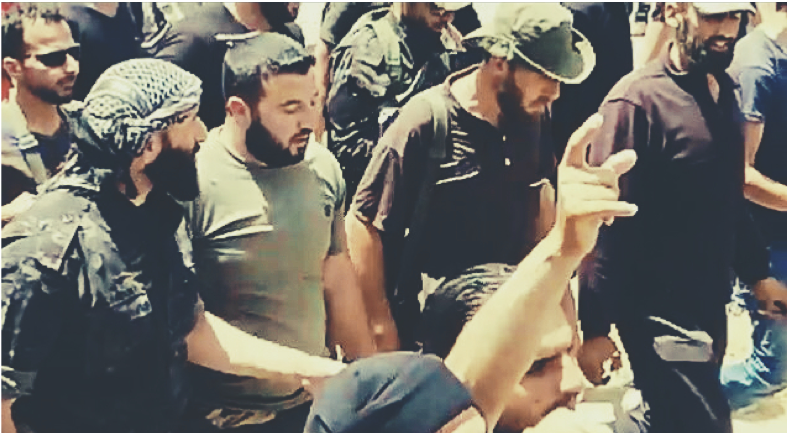
On June 20 a bus carrying soldiers from the Eighth Brigade of the Fifth Corps, travelling from Latakia to Busra al-Sham, hit a roadside IED near the town of Kahil in eastern Daraa, leaving nine dead and 13 injured. The following day, the funeral for the nine soldiers who died in the IED attack quickly turned into the largest protest Daraa has seen since 2018, including both Eighth Brigade fighters and hundreds of civilians from several nearby areas.