After more than two weeks of sustained public protests against the regime, the Iranian government has grown increasingly desperate to quell what has metastasized into a nationwide demonstration. Escalatory measures have included the use of live ammunition against unarmed protesters, widespread arrests, and promises of quick trials and executions for those found guilty. To date, the number of demonstrators killed is believed to exceed 2,600, but some estimates suggest the figure is much higher. Despite this and an internet blackout extending for more than a week, the protests have yet to cease, and debates on whether the ongoing domestic turmoil may finally bring down the regime in Tehran are pervasive.
Amid much discussion on how the United States might react to these events, on January 13, President Donald Trump issued a message over social media encouraging protesters to remain resilient and proclaiming “help is on its way.” This led to immediate speculation that the US was preparing for military action in Iran — a perception seemingly validated the following day, as reports surfaced that the US military had evacuated some personnel from al-Udeid Air Base in Qatar in the wake of a meeting between Trump and key US government principals. With signs pointing to the possibility of some sort of looming kinetic strike against Iran, the situation warrants at least a brief assessment of the fundamental factors pertaining to strategic intent, operational choices and limitations, and potential outcomes of such a policy course. The following analysis considers those issues in the context of the strikes carried out against Iran in June 2025 by Israel and the US during Operations Rising Lion and Midnight Hammer, respectively (frequently referred to as the 12-Day War). That examination concludes that, in the current context, the military options available to the US are more limited than mid-last year, the benefits less predictable, and the strategic risks heightened. Although Washington also has non-military responses, or the option of doing nothing, at its disposal — and indeed, Trump himself raised the prospect of using tariffs to heighten the pressure on Iran, and the US has already imposed new sanctions — those alternatives are outside the scope of this assessment.
Preparation for military action
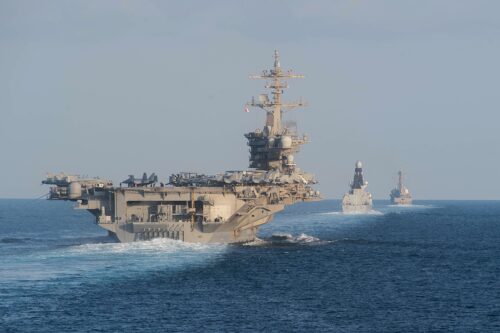
In the lead up to Operations Rising Lion and Midnight Hammer, the US Armed Forces significantly bolstered their force posture in the region, enhancing both their offensive and defensive capabilities. In the spring of 2025, the US Navy took the rare step of deploying not one but two aircraft carrier strike groups, USS Carl Vinson and USS Nimitz, to the Arabian Sea. It also directed an Arleigh Burke-class guided-missile destroyer, USS Thomas Hudner, to move from the western to the eastern Mediterranean. This armada, comprising roughly 20 warships, 150 aircraft, and more than 15,000 sailors and marines, collectively represented a substantial amount of strike and missile-defense capability. The US Army additionally repositioned a Patriot air-defense battalion from South Korea to al-Udeid Air Base in Qatar via 73 C-17 sorties in preparation for retaliatory attacks from Iran. While the primary strikes on Iran’s nuclear facilities were ultimately carried out by seven B-2 bombers based in the US, the aforementioned in-theater assets contributed materially to supporting the operation through launching Tomahawk missiles from air and sea platforms, intercepting Iranian missiles targeting Israel and Qatar, and deterring a more significant response from the Iranian regime.
Current US force posture in the region paints a different picture. At the time of Trump’s social media post, US Navy tracking showed all deployed carrier strike groups operating either in the Western Hemisphere or East Asia, thousands of miles from the Middle East. Though, on January 15, it was announced that a carrier strike group led by USS Abraham Lincoln was being directed to the Arabian Sea. Additionally, the Patriot battalion sent to help defend al-Udeid Air Base prior to Midnight Hammer returned to Osan Air Base in South Korea in late October. While some reports suggested this unit would be backfilled as part of a continued heightened alert, this has yet to occur. As a result, the US, for now at least, faces limitations on the scope, scale, and duration of any follow-on strikes it can consider. That also leaves key targets in the region (a network of US bases and installations, embassies, and Israel in general) more vulnerable to retaliation attacks.
Strategic objectives: What does “help” look like?
In the aftermath of the 12-Day War, both Israeli and US officials were insistent that regime change in Iran was not one of the objectives — notwithstanding some mostly symbolic actions by Israel that seemed to signal the opposite. Rather, the focus of the attacks were key military targets, including nuclear facilities, air defenses, ballistic missiles and launchers, and senior leadership. Thus, battle-damage assessments concluded that the Iranian nuclear program was set back at least several years, air defenses across western Iran were all but obliterated, Iran’s arsenals of ballistic missiles (2,500 down to 1,000) and launchers (375 down to 125) were significantly culled, and 30 senior commanders across Iran’s security forces were killed. While debate surrounding the longevity and societal impact of these actions has persisted, it was objectively clear that the military capabilities of the regime had been significantly damaged.
On the other hand, the insinuation from Trump’s “help” message this week was that the US will use military means to facilitate the collapse of the regime. The details surrounding the form this might take and expected outcomes have yet to be articulated, predictably instigating much discussion and conjecture. Importantly, during a visit to the White House just prior to the onset of the demonstrations, Israeli Prime Minister Benjamin Netanyahu reportedly proposed follow-on strikes once again centering on Iranian military targets. Trump was non-committal and no firm plan was approved. Developments are moving rapidly, however, and recent speculation is that a US strike may once again center on regime erosion insofar as it would degrade its military capabilities without directly targeting Iran’s supreme leader or other key political targets. This would ostensibly maintain Trump’s credibility and avoid the “Pandora’s Box” scenario presented by a sudden, full regime collapse while potentially extracting concessions in some future negotiations. Regardless of the ultimate intent of renewed attacks on Iran, any likely scenario will require confronting a distressed regime that has already resorted to violence against its own citizens and still maintains a substantial store of ballistic missiles — which are, by multiple accounts, being replenished with China’s help — and other levers to use against external threats.
Dealing with the aftermath of a US strike on Iran
Another key factor that must be considered is the potential Iranian reaction to US strikes. During the 12-Day War, Iran fired an estimated 550 missiles and roughly 1,000 drones at Israel; and while the majority were either intercepted or fell short of Israel’s border, the few that hit their targets caused significant damage. In total, 28 people were killed and more than 3,000 wounded in addition to extensive property damage. The US, on the other hand, escaped with limited physical damage. In what was widely perceived as a face-saving compromise, Iran fired a salvo of missiles at al-Udeid Air Base; by all accounts, the timing was choreographed with Qatari officials and the exact coordinates of these strikes were communicated in advance. With both US and Qatari air defenses engaging the attacks, the few missiles that got through landed in remote areas and failed to result in casualties. One significant cost, however, was the materiel expended in confronting the attempt. Reports show that the US used roughly one-quarter of its total stock of Terminal High-Altitude Air Defense (THAAD) interceptors in protecting Israel and al-Udeid. This amounted to at least 100 and potentially up to 150 interceptors. To put this in perspective, the US produced only 11 such missiles in 2023 and expected to acquire only another 12 in 2024. Israel also fired a considerable number of its interceptors and has similarly had to alter defense procurement plans to remain prepared for follow-on contingencies.
With the US eschewing any element of surprise in its current threats to strike Iran, the regime has stated clearly that its response to renewed attacks will not be limited. Though diminished compared to 2024, Iran’s ballistic missile inventory remained significant even before accounting for any replenishment over recent months. Iranian officials have reportedly reached out to their counterparts in Qatar, Saudi Arabia, the United Arab Emirates, and Turkey, warning that if Iran is attacked, US bases in each of these countries will be targeted. In an attempt to avoid retaliatory attacks and other blowback from US strikes, such as an influx of refugees in the wake of a potential governmental collapse, Saudi Arabia, Oman, and Qatar have lobbied to dissuade Washington from attacking Iran. Supporting these concerns, a report conducted in the wake of the 12-Day War concluded that US bases in the Middle East and the Gulf partner states that host them present the most vulnerable potential Iranian targets in the region. Finally, while Iran’s regional network of non-state proxy armed groups has also been significantly devastated or disrupted over the past several years by Israel’s forceful, multi-front response to the October 7, 2023, Hamas attack, many of these militant groups have, as a result, grown increasingly desperate. They may now be more amenable to coordinating wider attacks against US interests across the Middle East.
Proceed with caution
The 12-Day War of June 2025 is generally considered a military success, even if it left some ambiguity as to the status of Iran’s nuclear program, the country’s ability to replenish damaged and lost military equipment, the Iranian regime’s capacity to replace senior defense and security leadership en masse, and, most importantly, any lasting impairment to the regime itself. This success, however, came as a result of significant enhancements to US force posture in the region, built up over weeks and months, combined with specific, tangible objectives. As President Trump considers follow-on strikes in the wake of the Iranian authorities’ brutal suppression of street demonstrations, he should take these factors into account before proceeding with a military operation pursuing vague objectives that, even in a best-case scenario, will present uncertainties that are out of Washington’s control.
In weighing the risks of any new operation, the administration must also ensure that it has not learned the wrong lessons from the 12-Day War. From a posture and materiel standpoint, the US (and Israel) are less equipped to defend against an Iranian regime that, though weakened, may see fewer impediments to utilizing its still sizable arsenal of ballistic missiles against numerous vulnerable targets across the region. Relatedly, as events play out and potentially expand, there is no guarantee that Trump will once again be in a position to compel all sides to cease their activities at his demand, as he managed to do last June.
In sum, the decision calculus of an Iranian regime that is increasingly cornered and desperate has changed significantly since last June and any lessons taken from the 12-Day War must be considered in this context. A follow-on US intervention must be precise in what it expects to accomplish and should be weighed against a possible outsized response.
Jason H. Campbell is a Senior Fellow at the Middle East Institute, where he focuses on international security, geopolitics, and foreign policy.
Photo by Zachary Pearson- U.S. Navy via Getty Images
The Middle East Institute (MEI) is an independent, non-partisan, not-for-profit, educational organization. It does not engage in advocacy and its scholars’ opinions are their own. MEI welcomes financial donations, but retains sole editorial control over its work and its publications reflect only the authors’ views. For a listing of MEI donors, please click here.

The Americans Are Gone. Will Iraq’s Militias Disarm?