This individual is a guest contributor. MEI is not able to assist with contact requests.
David Mack is the former Deputy Assistant Secretary of State for Near East Affairs (1990-93) and US Ambassador to the United Arab Emirates (1986-89). Mack’s US diplomatic assignments included Iraq, Jordan, Jerusalem, Lebanon, Libya, Tunisia, and Saudi Arabia. Mack has extensive experience and knowledge on Iraq, Libya and UAE. He also comments on US Middle East policy and the security of the Arabian Peninsula and Persian Gulf region.
Special Briefing: The Middle East in the Year Ahead
Another turbulent year lies ahead for the Middle East. Civil wars rage in Syria, Libya, and Yemen; the battle against ISIS proceeds in Iraq; Iran pushes its advantage against regional rivals; governments continue to struggle with economic, political, and security challenges; and the region awaits a new administration in Washington.
Monday Briefing: Shiite Militias to Join Mosul Battle
In this week’s Monday Briefing, MEI experts Randa Slim, Robert S. Ford, and David Mack provide analysis on recent and upcoming events including updates on the battles for Mosul and Aleppo, and the potential meeting of Libyan factions currently locked in a stalemate.
Monday Briefing: President Obama's Final UNGA Address
In this week’s Monday Briefing, MEI experts Paul Salem, Robert S. Ford, Charles Lister, Alex Vatanka, and David Mack provide analysis on recent and upcoming events including Obama’s upcoming final speech to the UN General Assembly, the Syrian collapsed ceasefire, the buildup to an eventual Mosul offensive, Rouhani’s trip to Latin America, and Libya’s oil exports.
After the liberation of Sirte from ISIS, now the really hard work begins. The nine-member Presidential Council (P.C.) and the Government of National Accord (G.N.A.) that it named under Prime Minister Fayez Serraj have yet to receive an affirmative vote from the House of Representatives (H.O.R.) in Tobruk. Although a majority of H.O.R. members were prepared many weeks ago to confirm Serraj and his cabinet, speaker Aquila Saleh declined to bring the matter to a vote.
The Libyan Presidential Council (P.C.), representing a rough consensus of Libyan political forces, is making slow but promising gains in several key areas. There will probably be setbacks on the road to the kind of progress that will generate wider support from both key Libyan factions and the general populace. Signs are encouraging, however, in areas such as security and legitimacy. It is too early to say that the Government of National Accord (G.N.A.) appointed by the P.C. is truly governing, but it is taking steps that provide more confidence to the international community.
Some problems cannot be postponed indefinitely, and Libya is one of them. U.N. mediators, fronting for a hesitant and oft-divided international community, are running out of gimmicks for further talks among the feuding parties in Libya’s dysfunctional political process. Moving swiftly after his arrival in Tripoli last Wednesday, Prime Minister Fayez al-Sarraj reached out to the Libyan public, key central government institutions, and regional and municipal authorities.
Libyan Unity Government Efforts Need International Support
The international community is getting ready to put major assets behind Libyan efforts to restore their country’s official unity under a Government of National Accord (GNA). During recent weeks, statements from the United Nations, major European governments and the United States suggest that planning and coordination are underway to shore up the unity government. Key Arab governments are also showing awareness that their own national security is under threat due to the prolonged stalemate in Libyan politics.
Cold Lessons from the Balmy Euphoria of the “Arab Spring”
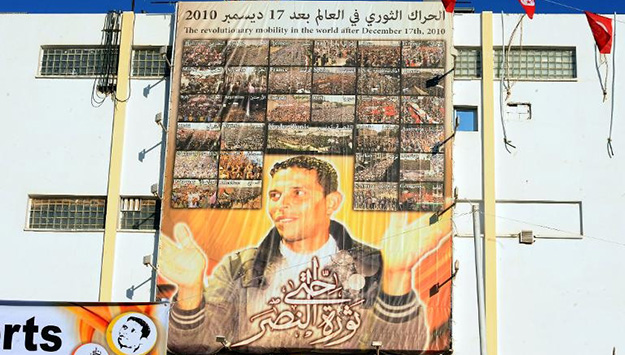
A desperate Tunisian fruit and vegetable vendor immolated himself on December 17, 2010, setting off a chain of demands for dignity and a better life. The past four years in the Arab world have seen vast turmoil, and the end is not yet clear. The Arab countries of the Middle East and North Africa are passing through their most abrupt and historic experience since decolonization and independence following World War II.
Obama and the Maghreb in the Wake of the Arab Spring
This paper is part of an MEI scholar series, titled “Obama’s Legacy in the Middle East: Passing the Baton in 2017.” Click here to view the full project, or navigate using the table of contents to the right.
Libyan popular and political support for engaging the international community offers the United States and Western partners an opportunity to help stabilize a North African energy producer and encourage orderly political change. Conversely, a failure to act could have costly, long-term regional and international security consequences. Domestic political limitations to direct U.S. government engagement, along with other issues that compete for attention and resources, are constraints on a more active policy. Moreover, Libyans themselves would not tolerate a dominating U.S. role.
The US and Libya: Normalization of a Stormy Relationship
*This article was first published in January 2011 by the Foreign Service Journal.
Relations between Libya and the U.S. have a turbulent history: War at the beginning of the 19th century; U.S. government support for Libyan independence after World War II; official and private-sector American engagement in the development of Libya’s oil wealth and human resources in the mid-20th century; Libyan terrorism and U.S. military retaliation in the 1980s; U.S.-engineered economic sanctions and isolation in the late 20th century; and restoration of diplomatic relations in 2006.
United States Will Pay a Heavy Price for the Gaza Flotilla Incident
Asserting its need to be secure from future terrorism launched from Gaza, Israel used force last week to maintain a blockade that has been creating a humanitarian cataclysm for the people of Gaza. In the early days following the attack on the aid flotilla, the Israeli military interpretation of events dominated much of the popular media coverage in the United States. Gradually, though, attention shifted to the incident’s negative impact on Israel’s international standing and the security implications of continued international and regional uproar.