







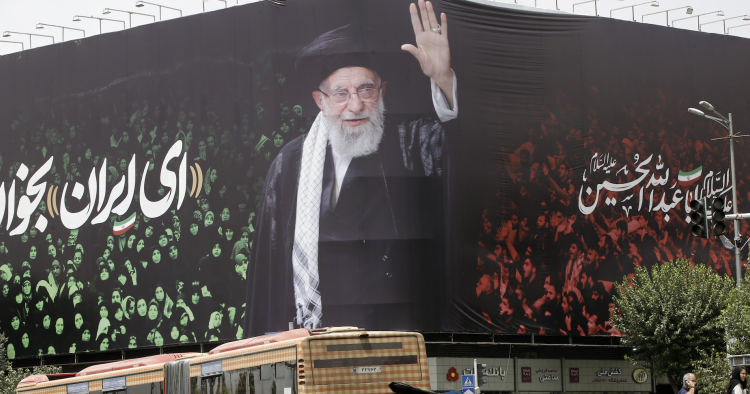
The 12-day conflict with Israel was brief, yet it left a scar. It was a war marked by unprecedented strikes deep inside Iranian territory that jolted the leadership in Tehran into confronting realities they had long sought to avoid. It is not simply that Israel was able to degrade Iran’s nuclear infrastructure and eliminate senior IRGC commanders with surgical precision,1 the strikes revealed something far more unsettling for Supreme Leader Ali Khamenei and his circle: the Islamic Republic’s deterrence architecture—its reliance on proxies, missile capabilities, and nuclear ambiguity—no longer guarantees the regime’s survival.
This recognition now shapes every aspect of Iran’s strategic calculus. From renewed nuclear negotiations with Washington to attempts at regional diplomacy via Omani, Qatari or Saudi intermediaries, Tehran is urgently seeking a way out of an existential crisis. But the choices facing Khamenei’s Islamist system are narrower than at any time since the Islamic Republic’s founding in 1979.
This article examines the regime’s predicament through five overlapping pressures: external threats, domestic divisions, economic decay, regional isolation and opportunity, and the looming question of whether Iran’s leaders are capable of a strategic reset, or whether the 12-day war will be remembered as the harbinger of a slow collapse.
The Middle East Institute (MEI) is an independent, non-partisan, non-for-profit, educational organization. It does not engage in advocacy and its scholars’ opinions are their own. MEI welcomes financial donations, but retains sole editorial control over its work and its publications reflect only the authors’ views. For a listing of MEI donors, please click here.