Skip to Content

Marvin G. Weinbaum

Senior Fellow

Marvin Weinbaum

Marvin G. Weinbaum is a senior fellow at the Middle East Institute (MEI), specializing in Afghanistan, Pakistan, and Iran. He is professor emeritus of political science at the University of Illinois at Urbana-Champaign, where he directed the university’s Program in South Asian and Middle Eastern Studies for 15 years.

Dr. Weinbaum’s research and teaching have centered on national security, state building, democratization, and political economy in South Asia. He is the author or editor of six books and has contributed over 100 scholarly journal articles and book chapters on Afghanistan, Pakistan, and broader regional issues.

From 1999 to 2003, Dr. Weinbaum served as an analyst for Pakistan and Afghanistan in the US Department of State’s Bureau of Intelligence and Research. He has also held Fulbright research fellowships in Egypt (1981–82) and Afghanistan (1989–90), and served as a senior fellow at the United States Institute of Peace in 1996–97. Over the course of his career, Dr. Weinbaum has received research awards from the Social Science Research Council, the Ford Foundation, the American Political Science Association, and other major funding institutions.

He holds a PhD from Columbia University, an MA from the University of Michigan, and a BA from Brooklyn College.

The Latest from Marvin G. Weinbaum

Filter by
288 Results
The Pakistan-Afghanistan conflict: A strategic concern for the US
  • Analysis
  • The Pakistan-Afghanistan conflict: A strategic concern for the US

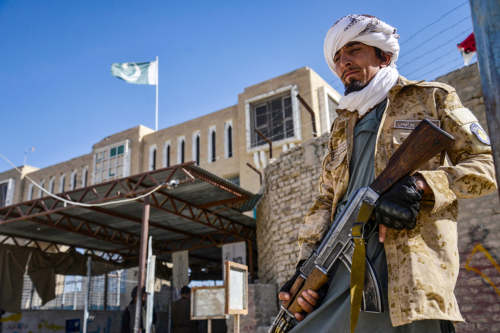
    Pakistan’s relationship with the Afghan Taliban has shifted from open sponsorship in the 1990s to a silent partnership following 2001 to alienation and belligerence since 2021. Their current conflict, which comes at great cost to both countries and seems to have no easy military or political resolution, also poses a threat to the stability and prosperity of neighboring states. Although American strategic interests in the region greatly diminished following the United States’ military withdrawal from Afghanistan in August 2021, the region’s altered political dynamics have prompted a growing American engagement with Pakistan and tentatively with Afghanistan. At the same time, the US has become a factor in how both Islamabad and Kabul have come to form their national security strategies.

    Unfinished business will drive the Mideast agenda in 2026
  • Brief
  • Unfinished business will drive the Mideast agenda in 2026

    Following another year of pivotal developments and transformational change, the Middle East could be poised to turn the page on many of its long-running conflicts and sources of instability. But lasting fruits of the processes begun in 2025 will require a determined, intentional focus by regional actors and the United States. Given current trends, MEI experts weigh in on where the region may be headed in 2026.

    Pakistan’s strategic defense pact with Saudi Arabia: A new security architecture in the wider Middle East
    Photo via Saudi Ministry of Foreign Affairs
  • Analysis
  • Pakistan’s strategic defense pact with Saudi Arabia: A new security architecture in the wider Middle East

    Following Israel’s September 9 strike on Hamas targets in Qatar, Pakistan has taken swift and significant foreign policy steps in response and adopted an unusually assertive stance. This shift was largely influenced by Pakistan’s military chief, Field Marshal Asim Munir. The latter is determined to enhance his country’s strategic autonomy and diplomatic leverage in an increasingly complex international environment by positioning Pakistan as a key security actor and an emerging middle power on the global stage.

    Pakistan’s ability to thread the needle in relations with the US and Iran tested by the Israel-Iran war
    Photo by AAMIR QURESHI/AFP via Getty Images
  • Analysis
  • Pakistan’s ability to thread the needle in relations with the US and Iran tested by the Israel-Iran war

    When the Israel-Iran war broke out and the United States decided to assist the Israeli side by striking Iran’s nuclear program, both Tehran and Washington expected Islamabad to side with their respective positions. This situation placed the Pakistani government in a politically sensitive and diplomatically delicate position.

    Trump travels to a Middle East in transition
    U.S. President Donald Trump boards Air Force One on May 12, 2025, at Joint Base Andrews, Maryland. President Trump is traveling to Saudi Arabia, the first stop on his four-day Middle East visit and the first international trip of his second term. Photo by Win McNamee/Getty Images
  • Analysis
  • Trump travels to a Middle East in transition

    This week, US President Donald Trump makes his inaugural visit to the Middle East since the start of his second term, traveling to Saudi Arabia, Qatar, and the United Arab Emirates on May 13-16. Amid the heightened focus on US policy toward the Middle East, MEI’s experts take stock of Trump’s trip to the Gulf, how his administration has shaped its approach to the wider region in its first several months, and how regional actors are responding to the policies coming out of Washington.

    Thousands of once protected Afghan refugees in the United States face deportation
    Photo by Marcus Yam/LA Times via Getty Images
  • Analysis
  • Thousands of once protected Afghan refugees in the United States face deportation

    The chaotic US military pullout from Afghanistan in August 2021 became a hot campaign issue in the 2024 presidential election and continues to echo today. President Donald Trump, who set the withdrawal in motion during his first term in office, repeatedly criticized President Joe Biden’s administration for leaving behind billions of dollars of military equipment. Also left behind were tens of thousands of Afghans, and their family members, who faced retribution for assisting US forces in the fight against the Taliban.

    US disengagement and new regional security dynamics in Afghanistan’s neighborhood
    Photo by Afghan Ministry of Foreign Affairs/AFP via Getty Images
  • Analysis
  • US disengagement and new regional security dynamics in Afghanistan’s neighborhood

    Afghanistan’s neighborhood is in the midst of a consequential restructuring of its security architecture. Key regional actors Pakistan, Afghanistan, Iran, and China have been continuing to adjust their defense plans and security partnerships to meet the growing threats posed by domestic and cross-border terrorism. At the same time, these four countries have also been looking for new ways to fill the vacuum in southern Asia left by the United States military’s departure from Afghanistan.

    Time for a more realistic approach to Afghanistan
    Photo by MUSTAFA NOORI/Middle East Images/AFP via Getty Images
  • Analysis
  • Time for a more realistic approach to Afghanistan

    Normalizing regular contacts and building relationships with the Taliban leadership can offer a more effective way to hold the Islamic Emirate to account for its actions. It also gives greater promise of realizing American hopes for an Afghanistan inhospitable to global terrorists and more respectful of the human rights of its citizens.

    Weekly Briefing: Syria reignites
    Photo by AAREF WATAD/AFP via Getty Image
  • Commentary
  • Weekly Briefing: Syria reignites

    In only six days, a broad coalition of advancing opposition forces coordinated by Hayat Tahrir al-Sham has captured all of Idlib province, almost all of Aleppo province, and a sizeable stretch of northern Hama — a humiliating defeat for Bashar al-Assad and illustrative of the fragility of regime rule in Syria.

    Weekly Briefing: A cease-fire for Thanksgiving?
  • Commentary
  • Weekly Briefing: A cease-fire for Thanksgiving?

    Read MEI’s weekly briefing featuring expert analysis of key regional developments for the week ahead.

    November 26, 2024
