






Please join the Middle East Institute (MEI) for a half-day conference focused on Syria one year into its historic transition.
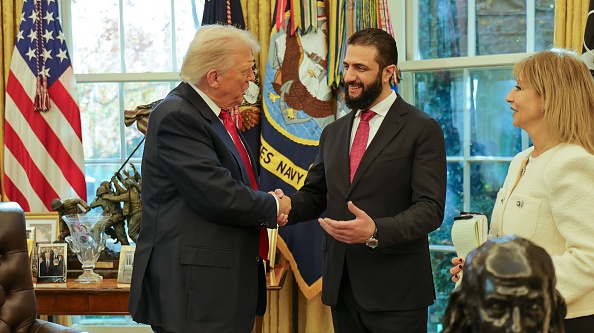
One year ago, the Assad regime in Syria came to a sudden and dramatic end, as opposition fighters advanced south from Aleppo into Damascus in a matter of days. As a long time global pariah, Syria’s re-entry into the international community has developed at rapid speed, with transitional President Ahmed al-Sharaa addressing the UN General Assembly in September and visiting the White House in November.
While Syria’s foreign policy successes have been clear, the challenges at home remain large and complex. From issues of sovereignty, security and political representation, to transitional justice, economic recovery and reconstruction, Syria has a long road ahead.
Event Agenda
8:45 AM - 9:00 AM: Introduction by Amb. (ret.) Stuart Jones
9:00 AM - 9:15 AM: Opening Remarks by Admiral Brad Cooper, Commander, US Central Command (virtual)
9:15 AM - 10:45 AM: Panel 1
Assessing US Policy on Post-Assad Syria & its International Integration
Amb. (ret.) Robert Ford, MEI
Amb. (ret.) Barbara Leaf, MEI
Charles Lister, MEI
Moderator: Dr. Kenneth Pollack, MEI
10:45 AM - 11:15 AM: Brunch served
11:15 AM - 12:45 PM: Panel 2
Charting a Path Forward in the New Syria
Mohammed Alaa Ghanem, Syrian American Council
Celine Kasem, Syrian Now
Jay Salkini, US-Syria Business Council
Moderator: Elizabeth Hagedorn, Al-Monitor
12:45 PM - 1:00 PM: Closing
Extended Speaker Biographies
Ambassador Stuart Jones joined MEI as its 18th president in January 2025. Stu came to MEI from Bechtel Corporation, a global engineering, construction and project management firm, where he was a senior vice president and President for Regions and Corporate Affairs. He retired from Bechtel in 2024. Prior to Bechtel, Stu served for three decades as a US Foreign Service Officer in the Department of State. His tours included US Ambassador to Iraq (2014-17), during the height of the ISIS crisis, and US Ambassador to Jordan (2011-14). Other foreign tours included Turkey, Egypt, El Salvador, and Colombia. He retired as the senior bureau officer (SBO) for the Bureau of Near Eastern Affairs, in 2017.
Vice Adm. Brad Cooper is the son of a career Army Officer. As a flag officer, he mostly recently served as commander, Naval Surface Force Atlantic. Previous tours include service as Chief of Legislative Affairs, where he lead the Navy’s engagement efforts with the U.S. Congress; commander, U.S. Naval Forces Korea during the height of tensions on the Korean Peninsula in 2016-2017; and commander, Expeditionary Strike Group 7 in Okinawa, Japan, where he lead U.S. 7th Fleet’s Navy-Marine Corps team on the U.S. military’s first F-35 deployment.
Amb. (ret.) Robert S. Ford is currently a senior fellow at the Middle East Institute in Washington where he writes about developments in the Levant and North Africa. Amb. Ford retired from the U.S. Foreign Service in 2014 after serving as the U.S. Ambassador to Syria from 2011 to 2014. In this role, Amb. Ford was the State Department lead on Syria, proposing and implementing policy and developing common strategies with European and Middle Eastern allies to try to resolve the Syria conflict.
Ambassador Leaf served as Assistant Secretary of State for Near Eastern Affairs from May 2022 to January 2025, overseeing 21 diplomatic posts, $7.5 billion in foreign assistance, and policies and programs from Morocco to Yemen. In the aftermath of Hamas’ brutal attack on Israel on Oct. 7, 2023, Ambassador Leaf acted as Secretary of State Blinken’s key advisor on intensive diplomatic engagement to foster conditions for a ceasefire and hostage release, address critical humanitarian needs for Gaza and promote a viable approach to post-conflict security and governance there. The first U.S. diplomat to go to Syria since the the US embassy’s closure in 2012, Ambassador Leaf set the terms for tough-minded U.S. engagement with the new leadership in Damascus following the fall of the Assad regime.
Charles Lister is a senior fellow and the director of the Syria Initiative at the Middle East Institute (MEI), where he focuses on Syria, terrorism, and insurgency across the Levant. His work also covers broader regional security dynamics and the evolution of jihadist movements, including al-Qaeda and the Islamic State (ISIS). Mr. Lister is concurrently a Senior Consultant to the Karam Shaar Advisory; the Founder of Syria Weekly; and a consultant to the United Nations' International, Impartial and Independent Mechanism (IIIM) for Syria. Mr. Lister also serves as an expert witness and advisor on counterterrorism for US, European, and Australian law enforcement and judicial bodies.
Celine Kasem is a human rights activist, humanitarian, and intercultural expert with extensive experience in international advocacy, foreign affairs, and humanitarian diplomacy. Specializing in Syria policy, refugee rights, and global advocacy, she has worked closely with policymakers, foreign leaders, and international organizations worldwide. Through digital education content and advocacy, she strives to bridge the gap between Syria and English-speaking audiences, raising awareness and fostering a deeper understanding of the complex realities on the ground.
Kenneth M. Pollack, PhD., is Vice President for Policy at the Middle East Institute. Previously he was a senior fellow at the American Enterprise Institute (AEI), where he worked on Middle Eastern political-military affairs, focusing in particular on Iran, Iraq, Saudi Arabia, and the Gulf countries. He began his career as a Persian Gulf military analyst at the CIA, where he was the principal author of the CIA’s classified postmortem on Iraqi strategy and military operations during the Persian Gulf War. Among other recognitions, Dr. Pollack was awarded the CIA’s Exceptional Performance Award twice and the Certificate of Distinction for Outstanding Performance of Duty, both for work on the Persian Gulf War.
Mohammed Alaa Ghanem is a leading Syrian civil society figure and a principal architect of Syrian American political advocacy. He currently serves as Policy Chief and Director of Government Affairs at the Syrian American Council (SAC), where he established and led the organization’s Washington, D.C. presence. Active in the Syrian pro-democracy movement since 2010, Ghanem first served as an editor for a digital platform that issued the original call for peaceful protests in Syria, and later became a nonviolent resistance strategist for the emerging Syrian Peaceful Protest Movement. He has advised senior U.S. officials across four administrations, made major contributions to landmark legislation including the Caesar Act and the Assad Regime Anti-Normalization Act, and is a frequent commentator in major media. Since the fall of the Assad regime on December 8, 2024, Ghanem has played a central role in efforts to secure the unconditional lifting of U.S. sanctions on Syria, working to stabilize the economy, rebuild institutions, and support national recovery throughout the transition period. Ghanem’s writings have appeared in The New York Times, The Washington Post, and other major publications. A native of Damascus, he is a former assistant professor at the University of Damascus and holds graduate degrees from Harvard and Columbia Universities.
Jay Salkini is a recognized entrepreneur, engineer, and industry leader. As the Founder and CEO of Tecore Networks, he has been instrumental in advancing mobile network infrastructure, pioneering scalable, secure, and adaptable solutions that support 2G, 3G, 4G, and 5G technologies across commercial, government, and defense sectors.Beyond technological innovation, he has played a key role in telecommunications policy discussions, participating in White House and Capitol Hill initiatives focused on network security, spectrum management, and the future of mobile connectivity. His industry expertise has made him a trusted voice in conversations surrounding wireless infrastructure development, public safety communications, and national telecommunications strategy.
Elizabeth Hagedorn is Al-Monitor's Diplomatic Correspondent covering events shaping US policy in the Middle East and North Africa. She reports on everything from sanctions and foreign aid to negotiations between Washington and regional powers. Since joining Al-Monitor, Elizabeth has traveled with the Secretary of State and conducted sit-down interviews with a range of foreign ministers and senior US officials. She previously reported on the region as a freelance journalist in Turkey and Iraq for publications including Middle East Eye, The National and The Guardian.